Building with AI: Lessons from Creating a Digital Budtender
There is a common assumption that building with AI starts with tools, models, or code. In practice, it usually starts somewhere much simpler.
It starts with a problem and a decision to solve it.
In this case, the problem & decision to pursue was straightforward. A friend of mine had a poor experience. He was trying to figure out what product to choose and the budtender behind the counter was a little less than helpful. This is relatively common from what he’s described with turnovers of staff, constantly changing product, and constant shortages of in demand substances. For the general customer, they may not know the terminology or they may not be able to clearly describe what they want. What they do have is a general sense of how they feel and how they would like to feel instead.
That gap between those two states is where the idea for an AI Budtender came from. The goal was not to build something technically complex. The goal was to make that decision easier.
This post is not meant to walk through each step of building the system. Instead, it focuses on the thinking behind it so the same approach can be applied to other ideas. Check out the video at the end of the post for a more in depth product overview.
Starting with the Decision
When building with AI, it is easy to focus on features first. Things like chat interfaces, recommendations, or personalization tend to come to mind quickly.
What matters more is understanding the decision you are trying to support.
In the Budtender example, the decision to pursue was not really about building an AI product. It is about helping someone move from their current state to a desired state. That could mean relaxing, focusing, or simply trying something new without feeling overwhelmed.
Once that is clear, the structure of the product starts to take shape. The questions, the flow, and the recommendations all become easier to define because they are tied to a specific outcome.
What is a Budtender?
A budtender is the person at a dispensary who helps customers choose the right product. A good budtender will listen to how someone feels and what they want to experience, then translate that into product suggestions using their understanding of effects and potency. They adjust recommendations based on the customer’s experience level and explain why a product fits and what to expect. The interaction is simple and conversational, focused on helping someone feel confident in their decision.
Designing the Interaction
Another early consideration was how the experience should feel to use.
Many early versions of AI products rely on forms. They present a set of inputs all at once and expect the user to work through them. While this can collect information quickly, it does not always align with how people naturally think.
In this case, a more gradual approach worked better. The system guides the user through a series of small questions. Each one builds on the previous answer. This creates something closer to a conversation than a checklist.
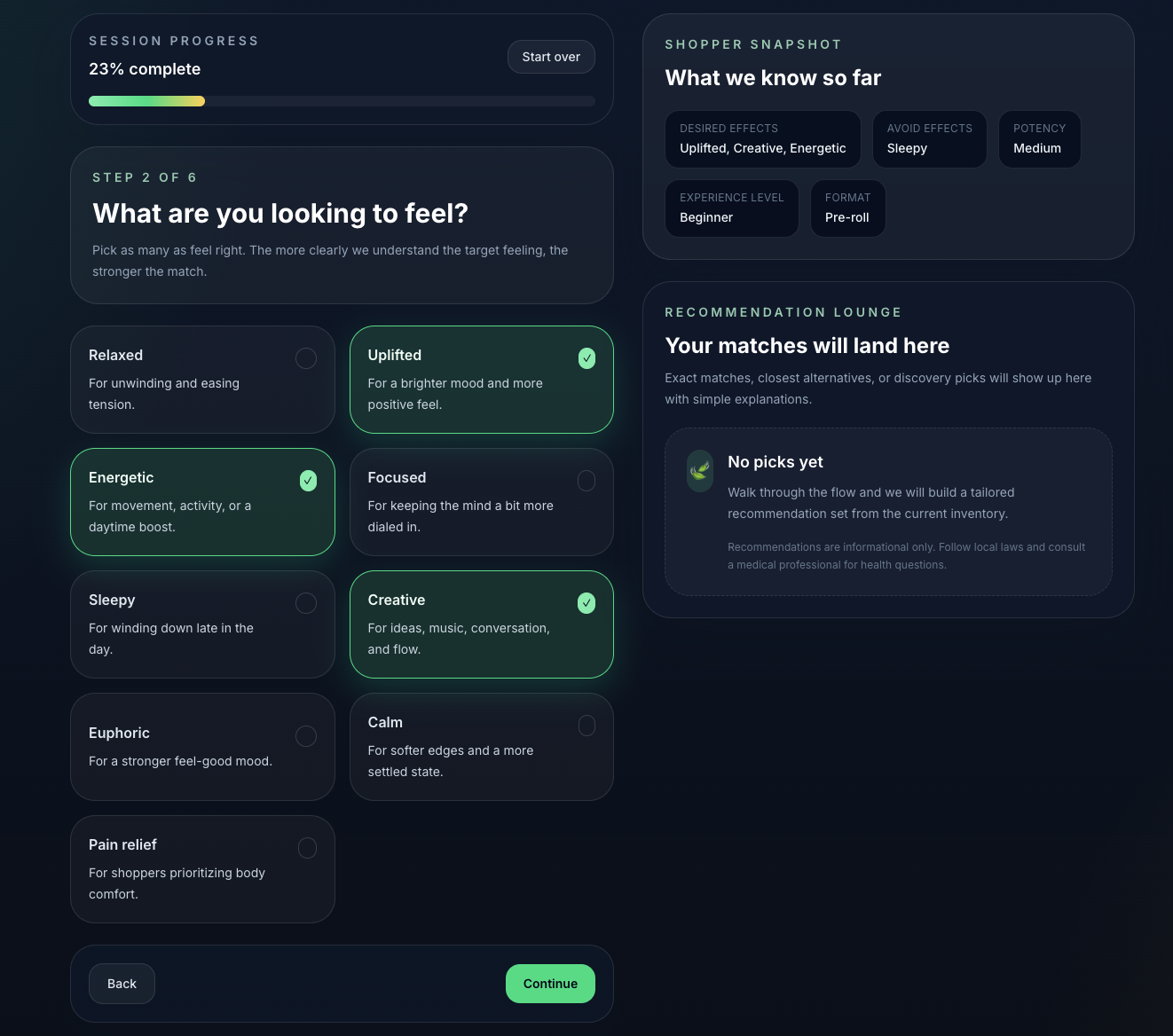
Step-by-Step Flow for Customers to Personalize their Experience
The goal is not just to gather information. It is to make the process feel clear and manageable.
The Role of Data
At some point, every AI product depends on the quality of its underlying data.
For the Budtender, that data includes product names, categories, descriptions, and key attributes like potency or effects. The system uses this information to determine which products are most relevant for a given set of preferences.
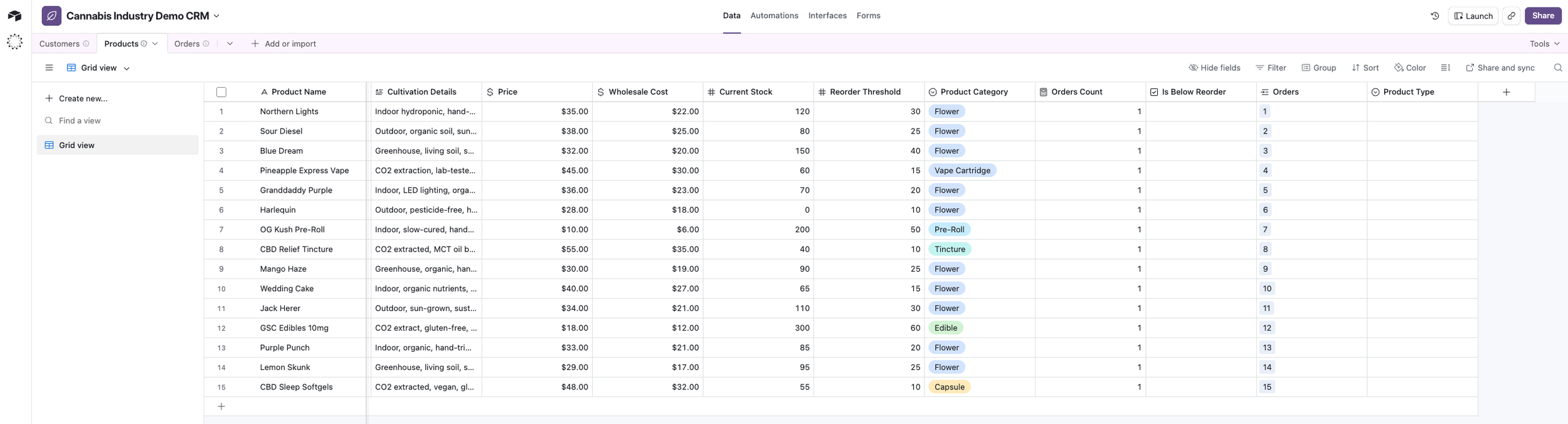
Product Information Stored in a Mock Inventory Management System (Built in AirTable)
If the data is inconsistent or incomplete, the recommendations will reflect that. If the descriptions are clear and structured, the system becomes much more reliable.
This part of the build is often less visible, but it has a direct impact on the overall experience.
Matching Preferences to Options
Once the user inputs and product data are in place, the system needs a way to connect the two.
The approach here is not about finding a perfect answer. Instead, it is about identifying which options are most aligned with what the user has shared. That alignment can come from multiple factors, such as desired effects, experience level, or preferred format.
There will often be trade-offs. A product might match on one dimension but not another. The system works by weighing those factors and returning the options that are closest overall.
This is less about precision and more about usefulness. We can always make it better later.
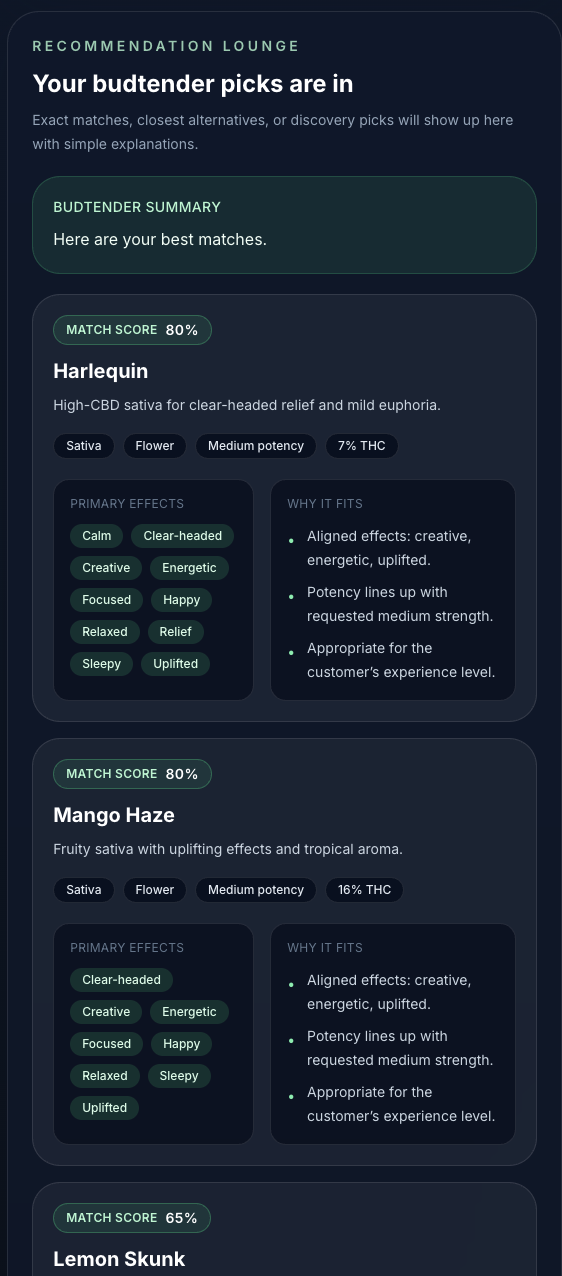
Recommendations Based on User Preferences
Providing Context with Recommendations
A list of products on its own does not provide much guidance. What makes the recommendations more helpful is the context around them.
Each suggestion includes a brief explanation that connects it back to the user’s inputs. This helps the user understand why a product is being shown and what they can expect from it.
Over time, this builds trust in the system. The user is not just receiving an answer. They are also seeing the reasoning behind it.
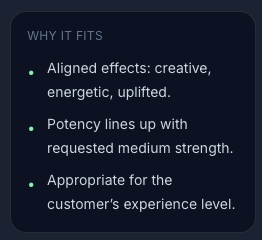
Aligning Effects to Users
Learning Through Use
After the initial version is built, the next phase is observing how it performs in practice.
Users may provide vague or conflicting inputs. Some recommendations may feel slightly off. Certain products may not fit cleanly into the existing structure.
These moments highlight areas for improvement. Adjustments can be made to the questions, the data, or the matching approach.
The system improves over time through this process.
Applying the Same Approach Elsewhere
While this example focuses on a Budtender, the underlying approach can be applied more broadly.
Many everyday decisions follow a similar pattern. Someone has a general goal, a set of preferences, and a range of possible options. The challenge is connecting those pieces in a way that feels clear and useful.
AI can help by organizing inputs, comparing them to available options, and presenting results in a way that is easy to understand.
The specific use case may change, but the structure remains similar.
Closing Thoughts
Building with AI does not require starting with complexity. It often begins by identifying a problem that people find difficult or time-consuming and choosing to pursue a solution to that problem.
From there, the focus shifts to understanding the user, structuring the information, and presenting helpful recommendations.
The Budtender is one example of how this can come together. The same principles can be used in many other areas where people are looking for guidance.
